
I Just Want Riding Boots That Fit
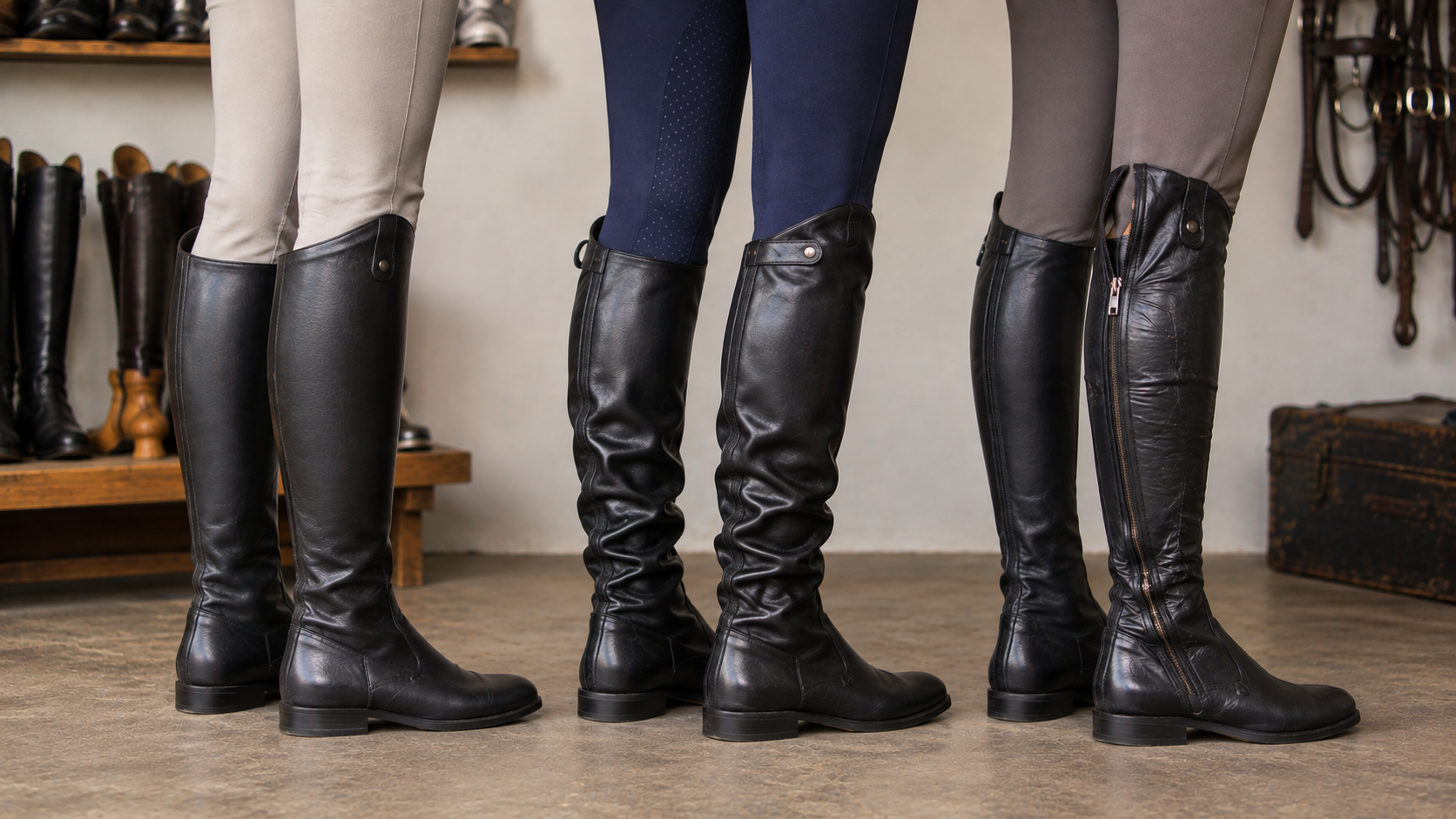
A riding boot can look beautiful, be made from the finest leather and be technically superb. But ultimately, one thing matters above all:
The boot has to fit properly.
After more than 65 years of working with riding boots, I know that shoe size, calf circumference and shaft height do not tell the whole story.
The shape of the leg, ankle, instep and foot all play an important role. The position and shape of the calf, the proportions of the lower leg, shaft height, zipper position and the construction of the particular model can all determine whether a riding boot truly fits.
Measuring is important. Understanding what those measurements mean is even more important.
On this page I have brought together my most important articles about riding boot fit, professional measuring, difficult leg shapes, standard and custom-made riding boots and the problems that can occur when a boot simply does not fit as it should.
Why Are So Many Nearly New Riding Boots Being Sold Second-Hand?
Facebook groups, equestrian marketplaces and other platforms contain a surprising number of expensive riding boots that have hardly been worn.
Sometimes they are even made-to-measure boots that have only been used a few times.
Why would someone spend hundreds of euros on a beautiful pair of riding boots, only to sell them again shortly afterwards?
I contacted several riders who were offering such boots for sale. Their experiences revealed remarkably similar patterns: problems with measuring and fit, insufficient support when a problem arose and alterations or repairs that had not always been carried out correctly.
Was there something wrong with the riding boot – or was it simply the wrong boot for that particular rider?
→ Read: Why Are So Many Nearly New Riding Boots Being Sold Second-Hand?
Measuring Riding Boots or Reading a Rider's Leg?
A measuring tape gives us centimetres. But those centimetres alone do not tell us which riding boot will actually fit the rider.
Professional fitting also requires looking at the shape of the leg, the ankle, the position and shape of the calf, the foot and the proportions between them.
Two riders can have exactly the same shoe size, calf circumference and shaft height – and still require completely different riding boots.
Measuring a leg and reading a leg are not the same thing.
→ Read: Measuring Riding Boots or Reading a Rider's Leg
Why Many Riding Boots Never Truly Fit
A riding boot can be technically perfectly made and still not fit correctly.
The wrong size, insufficient consideration of the shape of the leg or simply choosing the wrong model can result in an expensive pair of riding boots that is ultimately hardly ever worn.
A size chart is useful. But a size chart cannot see the rider standing in front of it.
→ Read: Why Many Riding Boots Never Truly Fit
How to Measure Riding Boots Correctly
Correct measuring remains the essential starting point when choosing riding boots.
Shoe size, calf circumference and shaft height must be measured correctly, but it is also important to understand where measurements should be taken and how the rider's individual proportions affect the result.
→ Read: How to Measure Riding Boots Correctly
Petrie Riding Boots: Standard or Custom (CYB)?
Custom-made is not automatically better, nor is it necessary for every rider.
With the correct combination of shoe size, shaft height and calf width, a standard-size Petrie riding boot can provide an excellent fit.
However, when the proportions of the foot and leg fall outside the available standard sizes, a custom-made boot can be the right solution.
The important question is not “Is custom-made better?” but “Does this rider actually need custom-made?”
→ Read: Petrie Riding Boots – Standard or Custom (CYB)?
Riding Boots for Strong Calves and Balloon Calves
A strong calf requires more than simply choosing a larger calf measurement.
The shape of the calf, the transition towards the ankle and the position of the widest part of the leg are at least as important in achieving the correct fit.
This becomes particularly important with balloon-shaped calves, where the proportions of the lower leg can differ considerably from a standard size chart.
→ Read: Riding Boots for Strong Calves and Balloon Calves
Riding Boots for Slim Legs
Very slim legs present their own fitting challenges.
Simply choosing the smallest available calf width is not always enough. The ankle, shaft height and proportions between the foot, ankle and lower leg all help determine which model will fit correctly.
A boot that is too wide around the ankle or lower calf can lose both its support and its elegant line.
→ Read: Riding Boots for Slim Legs
Petrie Dressage Boots: Fit, Top Curve and Zipper Position
A dressage boot places different demands on support, shaft height and overall lines than an all-round riding boot.
The height and shape of the top curve influence the appearance of the leg, while the position of the zipper affects construction, support, fit and the possibilities for future alterations.
These are not merely styling details. They are part of the way a riding boot fits and functions.
→ Read: Petrie Dressage Boots – Fit, Top Curve and Zipper Position
Riding Boots with a Front Zip or Back Zip – Which Is Better?
Zipper position is not merely a matter of personal preference.
A back zipper and a zipper positioned at the front or front-inside of the boot create different constructions. This can influence support, durability, fit and even the possibilities for professionally altering the shaft later.
There is therefore no universal answer to which zipper is “best”. The answer depends on the rider, the model and the intended use of the boot.
→ Read: Riding Boots with Front Zip or Back Zip
What Is Petrie CYB? Custom Riding Boots Explained
CYB stands for Customize Your Boot.
It offers possibilities beyond Petrie's standard-size collections, allowing the boot to be adapted to the individual rider in measurements, construction and selected details.
But CYB should not simply be regarded as the more expensive alternative to a standard boot.
The purpose of customization is to solve a fitting requirement or create a combination that cannot be achieved satisfactorily with a standard size.
→ Read: What Is Petrie CYB? Custom Riding Boots Explained
The Riding Boots Guide
Choosing a pair of riding boots involves considerably more than deciding which model looks best.
Dressage or all-round? Standard or custom? Which leather? Which shaft? Which zipper position? And how should a new riding boot fit when you first try it on?
Our Riding Boots Guide brings together practical information to help you understand the choices involved before ordering your next pair.
“Just Give Me Boots That Fit” – The Complete E-book
Would you like to go much deeper into riding boot fit, different models, measuring, leg shapes, standard sizes, made-to-measure options and the choices involved in buying a genuinely well-fitting pair of riding boots?
In my e-book “Just Give Me Boots That Fit”, I have brought together my knowledge and practical experience in one comprehensive guide.
→ Download “Just Give Me Boots That Fit”
More Than 65 Years of Experience with Riding Boots
The information on these pages is not based solely on size charts, manufacturers' catalogues or theory.
It is based on more than 65 years of practical experience with measuring, fitting, assessing, altering and repairing riding boots.
During all those years I have seen almost every type of leg and almost every type of fitting problem.
And my principle has remained remarkably simple:
A good riding boot does not start with the brand, the price or the model.
A good riding boot starts with the rider – and with the right fit.
Peter van Huet
Van Huet Riding Boots – Bunnik, The Netherlands